Have you ever noticed new plaster peeling off a wall or a fresh concrete overlay cracking within months?
If you are a professional contractor or a construction material distributor, you know that the biggest enemy of a successful project is bonding failure. Whether it’s called a concrete bonding adhesive, an interface agent, or a sand fixative (commonly used for treating dusting floors), this chemical tool is the only way to ensure structural integrity.
In this guide, we’ll explore the "when" and "why" of using concrete glue adhesive to prevent common issues like cracking and delamination.
1. What is a Concrete Bonding Adhesive?
Concrete bonding adhesive is a high-performance polymer, designed to create a permanent bridge between old, cured concrete and a fresh layer of mortar or stucco.
In the industry, it is often utilized as a bonding agent for concrete to concrete or bonding agent for stucco. Without it, the "thirsty" old substrate will absorb the moisture from the new mix too quickly, leading to a weak, brittle interface.
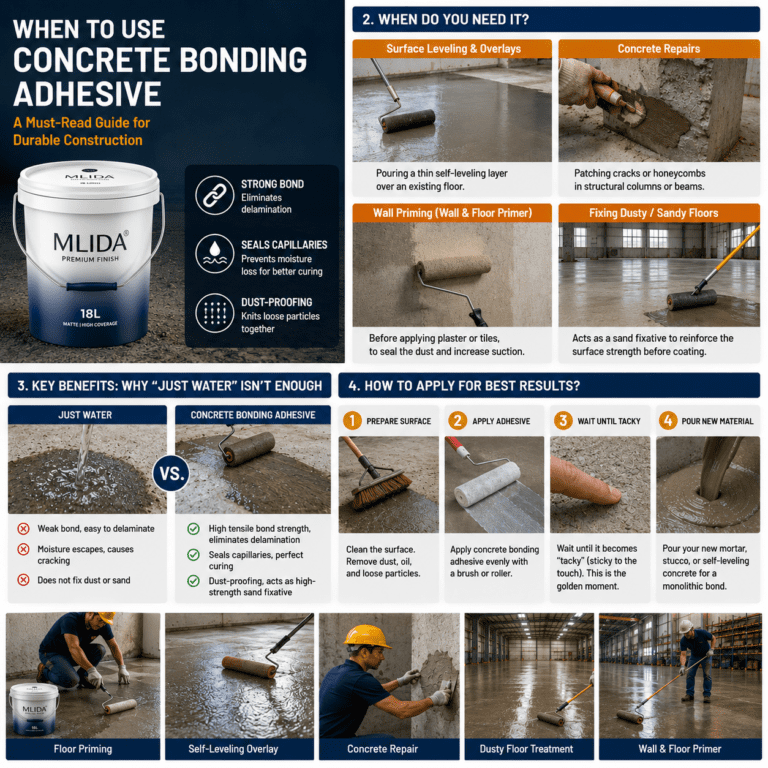
2. When Do You Need a Bonding Agent for Concrete?
According to technical standards, you should always use an adhesive for concrete in the following scenarios:
Surface Leveling & Overlays: When pouring a thin self-leveling layer over an existing floor.
Concrete Repairs: When patching cracks or honeycombs in structural columns or beams.
Wall Priming (The "Wall & Floor Primer" Role): Before applying plaster or tiles, to seal the dust and increase suction.
Fixing Dusty/Sandy Floors: When dealing with weak substrates, it acts as a sand fixative to reinforce the surface strength before further coating.
3. Key Benefits: Why "Just Water" Isn't Enough
Many DIYers try to save costs by simply wetting the surface with water. According to industry experts at E-Chem, concrete is naturally porous. When you apply a new layer of mortar or stucco, the old dry concrete sucks the moisture out of the new mix too quickly. This prevents proper hydration, leading to a weak bond. Therefore, pros use concrete bonding agent for three specific reasons:
Eliminates Delamination: It provides high tensile bond strength that water cannot offer. It creates a tacky, high-strength film that "glues" the two layers together.
Seals Capillaries: It blocks the moisture from escaping, ensuring the new concrete cures perfectly.
Dust-Proofing: It knits loose particles together, functioning as a high-strength sand fixative for old warehouses or factory floors.
4. How to Apply for Best Results?
The secret to how to use concrete bonding agent lies in the timing. You must apply the concrete bonding adhesive evenly with a brush or roller and wait until it becomes "tacky" (sticky to the touch). This tacky window is the "golden moment" to pour your new material for a monolithic bond.