Blog
The Comprehensive Guide to Liquid Waterproofing Coatings: Selecting the Optimal System for Professional Endeavors

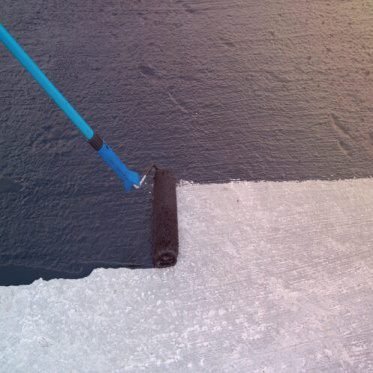
In contemporary construction, water serves as both a vital component and a silent adversary to buildings. From rooftop gardens subjected to heavy rainfall to underground foundations contending with hydrostatic pressure, effective moisture management is imperative.
Traditionally, rigid torch-on membranes have been prevalent in the industry. However, data from 2026 indicates a significant transition towards fluid-applied technologies. What accounts for this change? A liquid-applied waterproof coating addresses the most vulnerable aspect of any waterproofing system: the joints and seams.
Whether you are an architect creating designs for a commercial building, a roofing contractor addressing a recurring leak, or a distributor of building materials seeking to offer high-performance systems, grasping the chemistry of various liquid membranes is essential for ensuring structural durability.
What is a Waterproof Coating? (The Materials Science)
At the molecular level, a fluid-applied waterproof coating consists of a liquid formulation that includes specialized polymers, resins, and synthetic rubbers. Once applied, it cures to form a continuous, seamless, and elastomeric membrane that effectively seals the substrate.
Insights from materials science, as reported by ScienceDirect, indicate that the primary function of these coatings is to obstruct capillary pores found in concrete, masonry, or wood, while establishing an impermeable surface barrier against liquid water. Furthermore, the most advanced modern systems are designed to be "breathable," which means they prevent external liquid water from penetrating while permitting internal moisture vapor to escape, thus averting subterranean blistering.
Analyzing the Leading Waterproofing Systems: Which Type is Optimal?
Not all waterproofing projects are the same. A coating that performs well under the intense UV exposure of a commercial roof may fail dramatically if it is confined beneath a heavy concrete foundation slab. As a premier source factory in the industry, we classify the top high-performance systems as follows:
Liquid Rubber Waterproof Coating (The Champion of Flexibility)
In terms of extreme elongation and crack-bridging abilities, a liquid rubber waterproof coating is unparalleled. Usually made from modified bitumen, polyurethane, or specialized synthetic rubber emulsions, this coating functions like a liquid membrane.
- Key Benefit: It provides exceptional elasticity (often stretching between 500% and 800% of its original size without breaking). This characteristic enables it to accommodate the structural movements, thermal expansions, and contractions of a building.
- Ideal Applications: Flat roofs, metal roof restorations, balconies, intricate flashings, and regions with significant vibration or seismic activity.
- Application Advice: For commercial roof coatings, it is essential to apply in a multi-layer system with a UV-stable topcoat to safeguard the rubber polymers from deterioration due to direct sunlight.
Flexible Waterproof Coating (Cementitious Systems for Wet Areas)
As prominent experts in construction chemicals, such as Sika, emphasize, polymer-modified cementitious coatings represent the highest standard for both rigid and semi-flexible concrete surfaces. A flexible waterproof coating merges the durability of Portland cement with the flexibility of advanced liquid acrylic polymers.
- Key Advantage: Outstanding resistance to hydrostatic pressure and exceptional adhesion to moist concrete surfaces. It establishes both a mechanical and chemical bond with the concrete, guaranteeing that it will not delaminate even when subjected to negative-side water pressure.
- Best Used For: Water tanks, swimming pools, basements, waterproofing beneath bathroom tiles, and retaining walls.
- Application Tip: It is essential to apply an anti-alkali primer or a specialized concrete bonding adhesive to the substrate prior to application to seal the concrete dust and enhance the chemical bond.
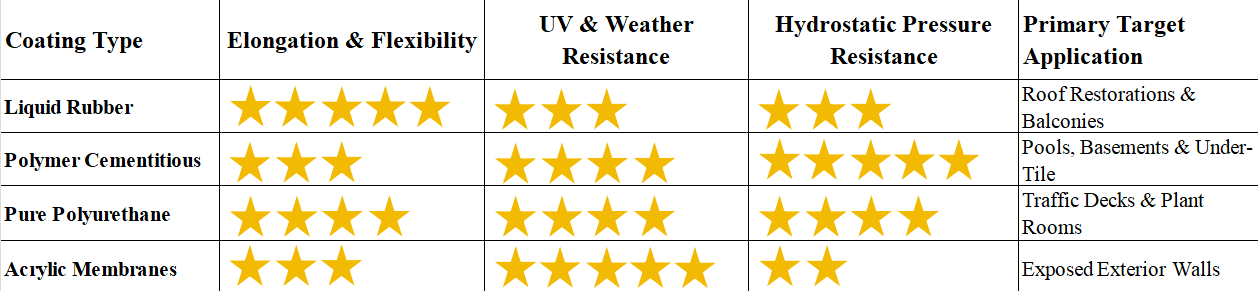
A Quick Comparison of Liquid Waterproofing Materials
To facilitate your project planning, below is a comparison of the main commercial waterproofing technologies based on essential engineering metrics:
The Engineering SOP: How to Apply Liquid Membranes Without Failure
A waterproofing system's effectiveness is determined by its application. More than 90% of failures reported in commercial projects stem from inadequate substrate preparation rather than the material itself. Adhere to this factory-approved 4-step SOP to ensure a leak-free finish:
Step 1: Substrate Preparation (The Golden Rule)
The concrete surface profile (CSP) must be clean, sound, and devoid of laitance, oil, dust, or curing compounds. Any cracks exceeding 1mm in width should be routed out and repaired using a non-shrink polyurethane sealant or high-strength mortar prior to coating.
Step 2: Priming & Bonding
Utilize a high-compatibility primer. This serves as an interface agent that stabilizes dusty concrete surfaces and controls the suction of porous substrates, thereby ensuring that the subsequent flexible waterproof coating adheres flawlessly.
Step 3: Reinforcement of Detail Zones
Transition areas, such as 90-degree wall-to-floor joints, pipe penetrations, and drainage outlets, are particularly susceptible to structural cracking. Embed a non-woven fiberglass mesh or polyester reinforcement fabric into the wet first coat of your liquid rubber waterproof coating across all joints to establish a robust reinforced matrix.
Step 4: Multi-Directional Layering
Avoid applying the entire thickness in a single heavy layer, as this can result in mud-cracking and improper curing. Instead, apply at least two coats. Once the first coat is dry to the touch, apply the second coat perpendicularly (at a 90-degree cross-hatch angle) to the first coat. This guarantees complete coverage without any pinholes.
The Commercial Value: Why B2B Buyers Collaborate with a Source Factory
For engineering contractors and large-scale distributors, acquiring waterproofing chemicals involves more than simply purchasing standard retail buckets. Establishing a direct partnership with a source factory that has 20 years of experience offers significant competitive benefits:
- Formulation Customization (OEM/ODM): Whether your project is situated in a tropical region that necessitates advanced UV inhibitors or in a cold climate that requires exceptional sub-zero elongation, formulas can be customized to meet your specific environmental requirements.
- Certified Performance & Trust: Professional projects require strict adherence to compliance standards. Obtaining materials that possess international standard certifications, detailed MSDS data, and CE marks guarantees a seamless approval process from project consultants and building inspectors.
- Cost-to-Lifecycle Efficiency: Although high-performance liquid rubber and flexible cementitious systems may incur a higher initial material cost compared to basic bitumen paint, their lifespan of 15 to 20 years significantly lowers maintenance expenses and warranty liabilities, ensuring a substantial long-term return on investment.