Blog
Natural, Permeable, and Elegant: Everything You Need to Know About Washed Stone Coating

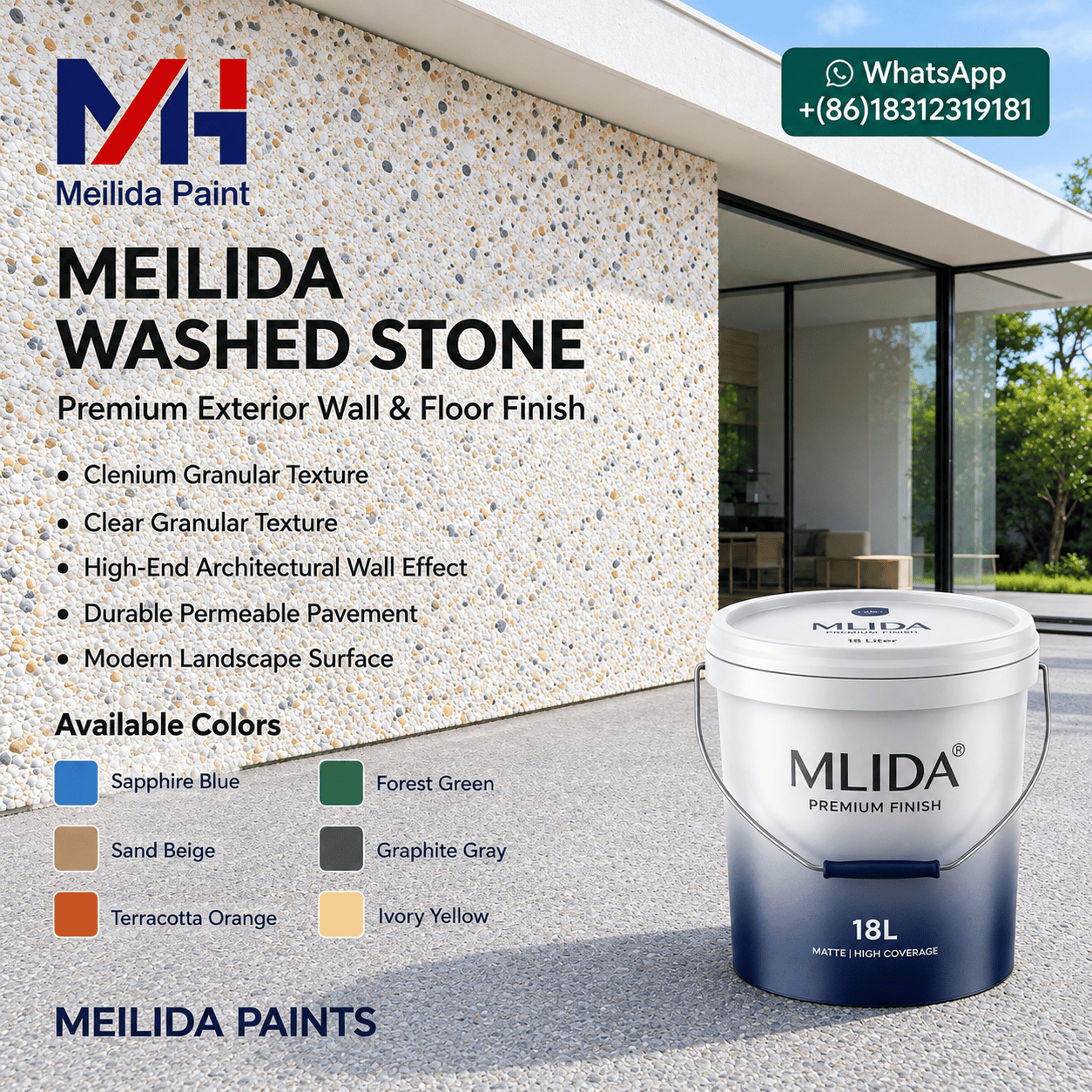
For landscape architects, commercial paving contractors, and interior designers, specifying surfaces for feature walls, outdoor pathways, and pool decks comes with a constant design dilemma. Traditional concrete slabs crack and pool standing water, tiles become dangerously slick when wet, and unsealed natural gravel constantly scatters.
Whether you are designing a luxury villa driveway, a feature accent wall, a hotel swimming pool deck, or an eco-friendly commercial plaza, here is everything you need to know about what washed stone coating is, how wall vs. floor specifications differ, and how to estimate materials for a zero-failure installation.
1. What Exactly is Washed Stone Coating?
Unlike traditional concrete or mortar-bound stone overlays, modern washed stone coating is a high-performance resin-bound aggregate matrix system. It blends natural washed river pebbles, crushed granite, or marble chips with a specialized, high-clarity clear resin binder.
Instead of hiding the stone under a thick opaque glaze, the clear resin coats each individual pebble, bonding them tightly together at their contact points. This creates a monolithic, heavy-duty surface that retains the raw, organic aesthetic of natural stone while remaining completely seamless underfoot or on vertical walls.
2. Specifications & Material Consumption Rates (Contractor’s Estimating Guide)
Whether applying washed stone coating as a thin micro-topping on vertical feature walls or as heavy-duty permeable paving for high-traffic outdoor driveways, selecting the correct aggregate grain size is essential for structural stability and accurate project bidding.
A. Fine Aggregate: 1mm (Vertical Wall Micro-Topping)
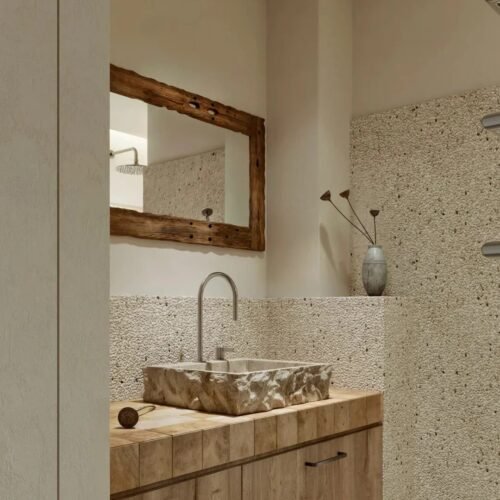
Fine aggregate is specifically engineered for vertical feature walls, curved pillars, and indoor accent surfaces, applied as a thin skim coat (1.5mm thickness).
- Target Application: Interior feature walls, facade cladding, curved reception desks, and architectural pillars.
- Material Consumption: 3.5 kg to 4.0 kg per sqm
- Coverage Yield: ≈ 0.25 sqm per kg of aggregate matrix.
B. Medium Aggregate: 2mm (Standard Indoor Flooring)
Medium-grain quartz and marble chips provide a dense, refined texture underfoot, making it the industry standard for seamless indoor commercial floors (2.0mm thickness).
- Target Application: Luxury retail showrooms, hotel corridors, indoor lounge floors, and gallery spaces.
- Material Consumption: 6.0 kg to 7.0 kg per sqm
- Coverage Yield: ≈ 0.14 sqm to 0.16 sqm per kg of aggregate matrix.
C. Coarse Aggregate: 3mm – 5mm (Heavy-Duty Outdoor & Courtyard Paving)
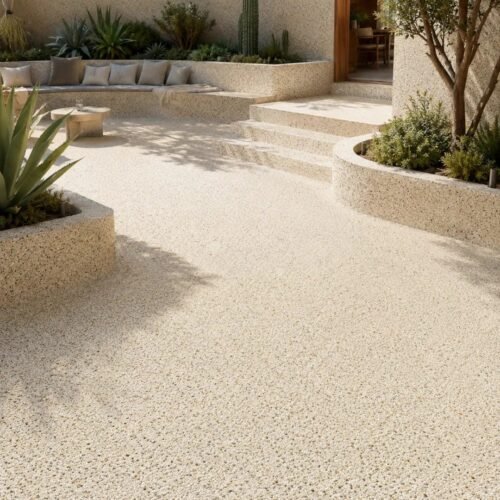
Coarse river stone and crushed granite chips deliver maximum mechanical interlock, superior drainage, and high slip resistance for outdoor environments (3.0mm to 4.0mm thickness).
- Target Application: Outdoor villa driveways, courtyard pathways, swimming pool decks, and public parks.
- Material Consumption: 12.0 kg to 14.0 kg per sqm
- Coverage Yield: ≈ 0.075 sqm per kg of aggregate matrix.
3. Key Advantages: Why Architects Specify Washed Stone Systems
Why are high-end commercial projects around the world replacing plain concrete, tiles, and plaster with resin-bound stone? It comes down to four massive engineering benefits:
- 100% Eco-Friendly & Permeable: Because outdoor floor stones are bound only at contact points, the surface features millions of microscopic interconnected voids. Rainwater drains straight through the stone matrix into the soil underneath, eliminating puddles and complying with green building drainage codes.
- Vertical Versatility: By adjusting the resin viscosity and utilizing 1mm fine aggregate, contractors can trowel washed stone onto vertical drywall, concrete columns, and exterior facades without slump or sagging.
- High Traction & Anti-Slip: The natural texture of rounded river stone or crushed quartz provides inherent multi-directional grip—even when completely wet. This makes it the premier choice for pool decks, ramps, and public walkways.
- Flexible & Thermal Crack Resistant: Unlike rigid ceramic tiles that snap under thermal expansion, high-grade resin binders retain subtle micro-flexibility, absorbing structural vibrations and seasonal temperature swings.
4. The 4-Step Success SOP for Commercial Installation
To ensure your washed stone surface never loses stones or turns yellow under the sun, your crew must follow this strict factory installation protocol:
Step 1: Substrate Preparation
Ensure the substrate (concrete, masonry, or drywall) is structurally sound, clean, dry, and free from loose debris or oil stains. Mechanical grinding is recommended for concrete slabs.
Step 2: Apply a High-Strength Bonding Primer
Raw concrete and plaster absorb moisture, which weakens the bond between the resin-stone mix and the base.
Step 3: Mixing and Troweling the Aggregate Matrix
Blend the dried, washed stone aggregates with Part A and Part B of your clear binder in a mechanical mixer for 3 to 5 minutes until every stone is uniformly coated. Trowel smoothly onto the primed surface to your target specification (1.5mm for 1mm fine wall sand; 10–18mm for outdoor heavy paving).
Step 4: UV Sealing for Long-Term Color Retention
Standard epoxies yellow when exposed to direct sunlight over time.
Direct Factory Sourcing for High-Volume B2B Supply
When bidding on large-scale municipal parks, hotel resorts, or commercial developments, buying retail DIY stone-glue kits ruins your profit margins and risks severe batch-to-batch color variations.
Operating from our 7,000-square-meter manufacturing plant with 20 years of intensive R&D, we produce premium washed stone coating systems and chemical binders engineered for extreme indoor and outdoor durability. We support contractors, distributors, and trading partners across global markets with complete certified systems, from deep-penetrating concrete bonding primers to non-yellowing aliphatic resins, all backed by complete MSDS and CE safety compliance certifications. With our comprehensive OEM/ODM capabilities, we can customize resin cure times for hot climates and custom-blend natural aggregate colors to match your architectural project specs.