
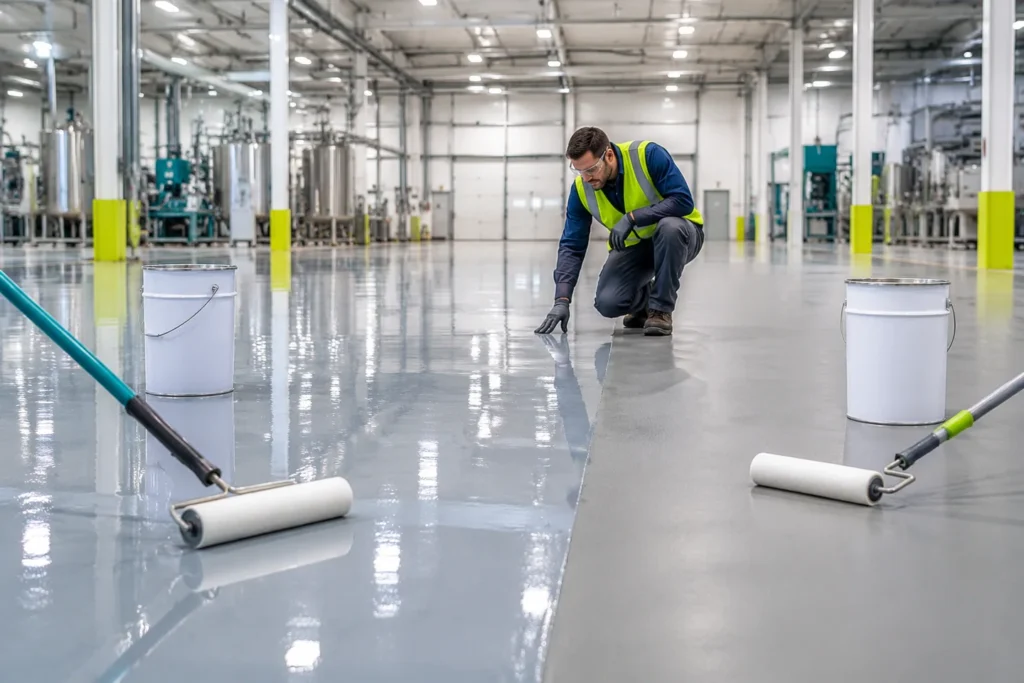
Epoxy is commonly selected for strong adhesion, build and chemical-resistant industrial layers, while polyurethane is often chosen as a flexible, abrasion-resistant or UV-stable topcoat. The correct specification depends on concrete condition, exposure and the complete primer-to-topcoat system.
Industrial buyers often ask whether epoxy or polyurethane is the better floor coating. The useful answer is not a universal winner. Each resin family contributes different properties, and many durable factory floors combine an epoxy primer or build coat with a polyurethane topcoat.
What is an epoxy floor coating?
Epoxy coatings are two-component systems valued for adhesion to properly prepared concrete, mechanical strength, film build and resistance to many oils and chemicals. They are widely used in factories, warehouses, workshops, parking areas and production rooms.
Epoxy is sensitive to substrate moisture, mixing ratio, pot life and surface preparation. Some epoxy finishes can discolor or chalk under direct sunlight, so exterior or UV-exposed projects need a suitable topcoat or an alternative resin route.
What is a polyurethane floor coating?
Polyurethane floor coatings are commonly used where abrasion resistance, flexibility, color retention or UV stability is important. They can provide a smooth satin or gloss finish and may tolerate movement better than a rigid high-build epoxy layer.
Polyurethane is frequently specified as a topcoat rather than the only layer. Product chemistry varies, so curing conditions, recoating compatibility and chemical resistance must be confirmed for the exact system.
Epoxy versus polyurethane: key selection factors
| Requirement | Typical epoxy strength | Typical polyurethane strength |
|---|---|---|
| Concrete adhesion and build | Strong primer and high-build options | Often used over a compatible base system |
| Abrasion and flexibility | Hard, strong film | Often better flexibility and scratch resistance |
| UV and exterior color retention | Product dependent; aromatic grades may yellow | Aliphatic grades are commonly preferred |
| Finish | Gloss, self-leveling and textured systems | Gloss, satin and UV-stable topcoat options |
Start with the concrete, not the product name
Record concrete age, compressive strength, moisture, contamination, cracks, joints and any existing coating. Grinding, shot blasting, repairs and moisture control influence performance more than a marketing label. A coating cannot compensate for a weak or contaminated substrate.
Define service exposure and film build
Tell the manufacturer about forklift or pedestrian traffic, impact, oils, acids, solvents, cleaning agents, hot-water washing, slip resistance, operating temperature and expected service life. These details determine primer type, intermediate thickness, aggregate use and topcoat selection.
Information required for a useful quotation
- Floor area and concrete condition
- Indoor, outdoor or sunlight exposure
- Traffic and chemical environment
- Target color, gloss and slip resistance
- Application method and available downtime
- Estimated quantity, package size and destination
For many factories, the best answer is a compatible system: prepared concrete, suitable primer, epoxy build layer and polyurethane topcoat. Samples and a written specification should be approved before commercial supply.
Common industrial floor system options
A thin roller-applied coating may be suitable for light duty and dust control, while self-leveling or mortar systems are considered for higher build, leveling and mechanical demand. Decorative flakes, quartz aggregate or anti-slip broadcast can change texture, cleanability and application cost. The selected route should match traffic rather than an arbitrary thickness.
Common specification mistakes
Frequent mistakes include quoting without moisture information, applying over weak concrete, ignoring expansion joints, selecting gloss without considering slip risk, and comparing price per bucket instead of installed coverage. Buyers should request batch information, mixing instructions, pot life, recoat window and the recommended inspection method.
Questions related to this coating topic.
Is polyurethane always better than epoxy for factory floors?+
No. Polyurethane may offer better UV stability, flexibility or abrasion performance, while epoxy may provide stronger build and concrete adhesion. Many systems use both.
Can epoxy floor paint be used outdoors?+
Some products can be used with a UV-resistant topcoat, but standard aromatic epoxy may discolor under sunlight. Confirm the complete exterior system.
How many coating layers are required?+
The number depends on substrate condition, film thickness, traffic and finish. A system may include primer, repair or intermediate layers and one or more topcoats.