
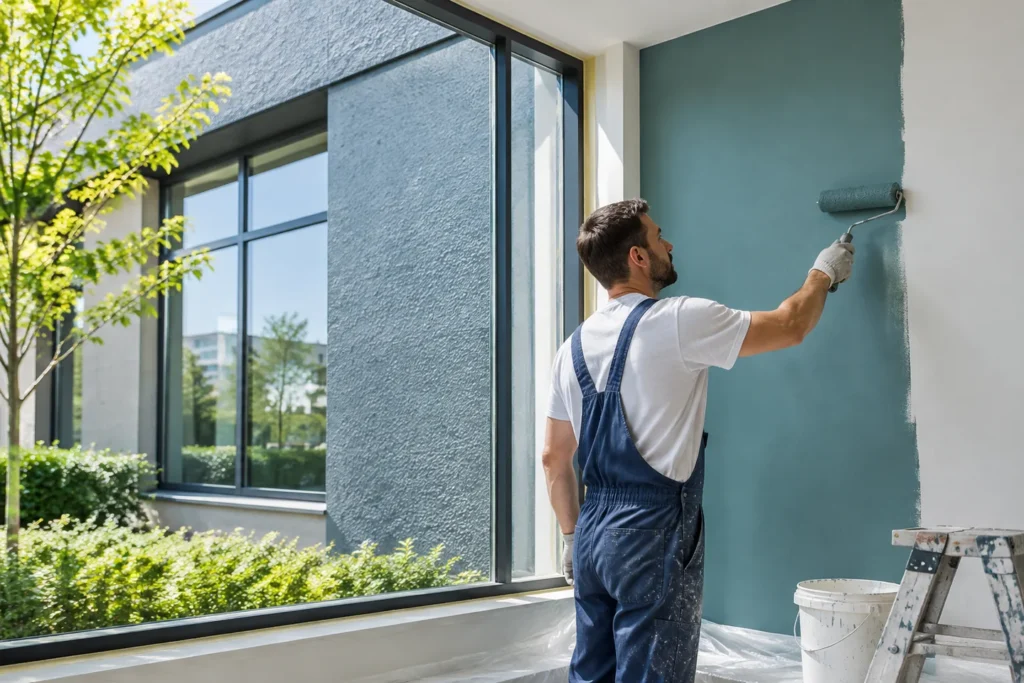
Interior wall paint prioritizes indoor appearance, washability, low odor and occupant requirements. Exterior wall paint must also resist rain, UV, temperature change, algae, dirt and substrate movement. The primer, wall condition and local climate should be defined before choosing a formula.
Interior and exterior wall paints may look similar in a container, but they are designed for different exposure. Distributors and project buyers should compare the complete performance brief instead of choosing only by color or price.
What interior wall paint must do
Interior coatings are normally evaluated for appearance, coverage, washability, stain resistance, low odor, application feel and suitable emissions requirements. The correct grade depends on bedrooms, offices, schools, kitchens, hospitals or high-traffic commercial walls.
What exterior wall paint must do
Exterior coatings face UV, rain, humidity, dust, algae, temperature cycling and movement in plaster or masonry. Important properties may include water resistance, weathering, color retention, dirt pickup resistance, crack bridging and adhesion after wet exposure.
Substrate and primer selection
New plaster, concrete, masonry, skim coat and previously painted walls absorb moisture differently. Check curing, alkalinity, powdering, cracks, efflorescence and old coating adhesion. A sealer or alkali-resistant primer can stabilize absorption and improve the finish, but it cannot repair a weak wall.
Color, sheen and decorative finish
Specify matte, eggshell, satin or gloss together with color reference and viewing conditions. For texture paint, mineral effects, Venetian plaster or art coatings, approve a physical panel because application technique changes the final appearance.
How distributors should define product tiers
- Economy interior coating for price-sensitive residential use
- Washable premium interior paint for commercial or high-traffic walls
- Standard exterior coating for moderate climates
- Higher-performance exterior coating for strong UV, rain or humidity
- Decorative texture and art-finish products with sample approval
Information to send the manufacturer
Provide substrate, interior or exterior exposure, climate, target coverage, washability, weather resistance, sheen, color, package size, expected quantity, destination and private-label requirements. If you have a benchmark, send the sample and test method rather than only the brand name.
Climate changes the exterior formula brief
A coating for a hot, humid coastal city faces different stress from one used in a dry high-UV market or a cold freeze-thaw climate. Tell the manufacturer about annual rainfall, humidity, sunlight, temperature range, algae risk and nearby industrial pollution. These conditions influence binder, pigment, additives and the recommended maintenance interval.
Application conditions affect the finished wall
Roller pile, spray pressure, dilution, number of coats, drying time and contractor technique affect hiding, texture and color uniformity. Dark colors may require a suitable base coat and careful batch control. Texture products should be evaluated by consumption per square meter and finished sample, not only container weight.
Private-label wall paint purchasing
For a private-label range, define which products are economy, standard and premium. Specify net content, bucket type, label language, tinting method, color-card support and required documents. A clear tier structure prevents overlapping formulas and makes distributor training easier.
Questions related to this coating topic.
Can interior paint be used outside?+
It is generally not recommended because interior paint may lack the weathering, UV, moisture and biological resistance required outdoors.
Does every wall need primer?+
Primer need depends on porosity, alkalinity, powdering, stains, repairs and the finish coat. The substrate should be inspected before specifying the system.
How should buyers compare coverage?+
Compare spreading rate at an equivalent dry-film build and substrate condition. Very high theoretical coverage may not reflect practical application on porous walls.