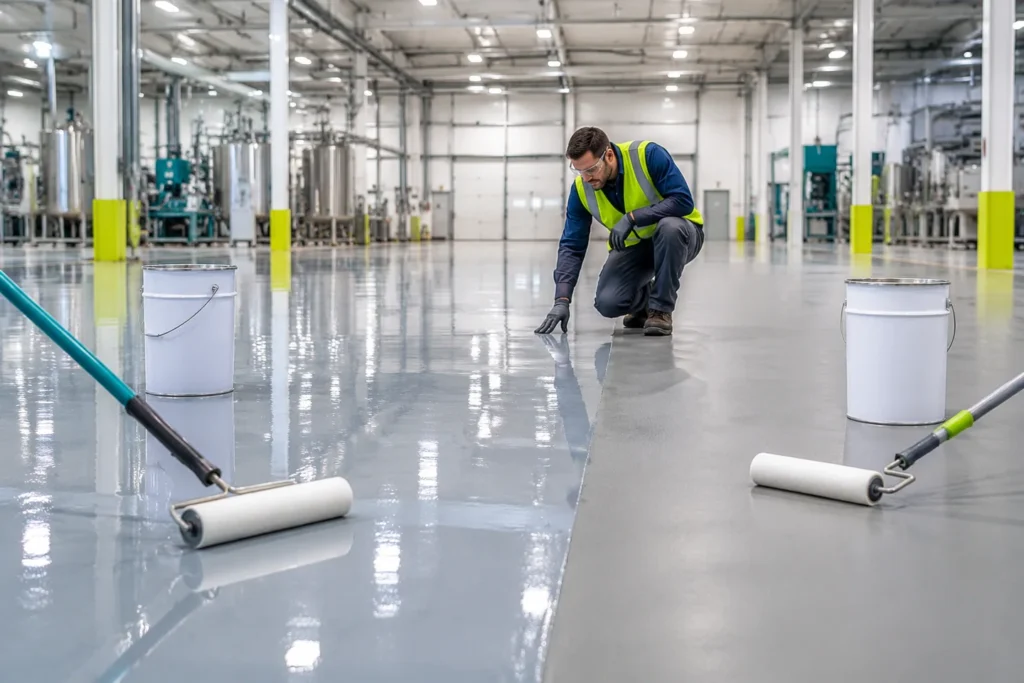
Epoxy floor coating failure often involves substrate weakness, moisture, contamination, mixing errors or unsuitable application conditions. Identify the failure mechanism before preparing and rebuilding a compatible floor system.
Epoxy floors rarely fail because of one isolated issue. Peeling, bubbles, pinholes, soft cure and early wear usually reflect a combination of concrete condition, surface preparation, moisture, application control and system selection.
For distributors, contractors and project buyers, the most useful question is not simply, “Which epoxy is strongest?” It is, “Which complete floor system matches this concrete, environment and service condition?” If you are still comparing resin technologies, start with our epoxy vs polyurethane floor coating guide. This article focuses specifically on why epoxy systems fail and how to prevent repeat failures.
How to recognize an epoxy floor coating failure
A failed floor does not always look the same. The visible symptom provides an important clue, but the coating should be investigated from the concrete upward before a repair method is selected.
| Visible symptom | Likely areas to investigate |
|---|---|
| Large sheets peeling from clean concrete | Surface preparation, laitance, contamination, concrete strength and moisture |
| Raised blisters or bubbles | Moisture vapor, concrete outgassing, temperature changes and trapped air |
| Small pinholes or craters | Porous concrete, insufficient primer, outgassing and application technique |
| Soft, sticky or uncured areas | Mixing ratio, incomplete mixing, pot life, temperature and contamination |
| Cracks through the coating | Concrete movement, active cracks, joints and rigid system selection |
| Early scratches, wear or chemical damage | Film thickness, cure time, traffic, chemical exposure and topcoat selection |
1. Weak, damaged or insufficiently cured concrete
An epoxy system can only bond as well as the concrete beneath it. Weak surface paste, laitance, dusting concrete, poor repairs and low-strength toppings can separate under stress even when the epoxy itself remains bonded to the upper layer.
What it looks like: The coating lifts with a thin layer of concrete or powder attached to its underside. Failure may be concentrated around damaged concrete, old patches or heavily trafficked areas.
How to prevent it: Inspect the substrate before pricing or installation. Identify weak concrete, hollow repairs, cracks, spalls and curing history. Many specifications use 28 days as a general concrete-curing benchmark, but the actual requirement must follow the selected product data and verified moisture condition. Weak material should be removed and repaired with a compatible system before coating.
2. Inadequate mechanical surface preparation
Acid washing, light sanding or cleaning alone may not create the profile required for a high-build industrial epoxy. The concrete must be opened sufficiently to remove laitance and provide a clean, sound surface profile for the primer and coating.
What it looks like: Delamination occurs across broad areas, especially where the surface remains smooth or glossy. Adhesion may vary according to how aggressively different areas were prepared.
How to prevent it: Specify the preparation method and required concrete surface profile before installation. Shot blasting, diamond grinding or another approved mechanical method should match the coating thickness and substrate condition. Vacuum dust thoroughly and inspect edges, corners, drains and column bases, not only the open floor.
The International Concrete Repair Institute classifies concrete profiles using CSP reference levels. The correct profile is system-specific, so the coating manufacturer, project specification and preparation contractor should agree on the target before work begins.
3. Moisture vapor or a damp concrete slab
Moisture is one of the most common causes of epoxy floor coating failure. Water vapor moving through concrete can create pressure beneath a low-permeability coating. Moisture may also interfere with primer penetration and cure.
What it looks like: Blisters, bubbles, dark areas, mineral deposits, localized delamination or repeated failure after repair. Problems may become more visible after wet weather, seasonal changes or building operation begins.
How to prevent it: Do not rely only on surface appearance or a handheld meter. Use the moisture test method required by the project and compare the results with the coating manufacturer’s limits. ASTM F2170 in-situ relative humidity testing and ASTM F1869 moisture-vapor emission testing are commonly referenced methods in flooring specifications.
If the results exceed the standard system limit, investigate the moisture source and use only a manufacturer-approved mitigation primer or alternative floor system. A moisture-tolerant primer is not a substitute for stopping active water leakage or hydrostatic pressure.
4. Oil, dust, salts or invisible surface contamination
Concrete in workshops, food facilities, garages and existing factories may contain oil, grease, detergent residue, silicone, salts, old curing compounds or chemicals that remain after ordinary cleaning. Grinding can also spread oil deeper or contaminate adjacent areas if the substrate is not assessed first.
What it looks like: Fish-eyes, craters, isolated peeling, poor wetting or failure that follows old spill patterns. Adhesion may appear acceptable in clean areas and fail around machinery or traffic lanes.
How to prevent it: Identify the facility history and perform trial preparation where contamination is suspected. Degrease using a suitable method, remove residue, allow the concrete to dry and verify adhesion with a representative test area. Severely oil-saturated concrete may require deeper removal and repair rather than additional primer.
5. Incorrect mix ratio, incomplete mixing or expired pot life
Two-component epoxy depends on the specified resin-to-hardener ratio. Splitting kits without accurate measurement, scraping unmixed material from container walls or applying material after its usable pot life can produce soft, sticky or unevenly cured areas.
What it looks like: Soft patches, tackiness, color variation, low hardness, uneven gloss or coating that marks under light pressure. The problem may follow individual mixing batches.
How to prevent it: Use complete factory-proportioned kits unless the manufacturer provides an approved method for splitting them. Pre-mix components when instructed, combine them for the specified time with the correct mixer, transfer to a clean container when required, and never extend pot life by adding solvent. Record batch numbers, mixing time and application time for larger projects.
6. Unsuitable temperature, humidity or dew-point conditions
Cold conditions slow curing and can contribute to surface defects. High temperatures shorten pot life and reduce working time. Condensation on concrete or fresh coating can damage adhesion and appearance even when the floor does not look visibly wet.
What it looks like: Amine blush, dull or cloudy patches, slow cure, poor intercoat adhesion, roller marks, bubbles or inconsistent gloss.
How to prevent it: Measure air temperature, substrate temperature, relative humidity and dew point before and during application. Many coating specifications require the substrate to remain at least 3 degrees C above the dew point, but the exact limit must follow the product data sheet. Maintain ventilation without blowing dust across the wet surface, and account for temperature changes during evening and overnight curing.
7. Outgassing, incorrect film thickness or missed recoat windows
Porous concrete releases air as its temperature rises. If epoxy is applied while the slab is warming, the escaping air can form bubbles and pinholes. Applying too much material in one coat can trap air or generate excessive heat, while applying too little can leave weak coverage. A missed recoat window can reduce intercoat adhesion.
What it looks like: Pinholes, small craters, bubbles, ridges, sagging, uneven texture or separation between coating layers rather than from the concrete.
How to prevent it: Use a compatible primer to seal porous concrete, apply during stable or falling substrate temperatures when practical, and follow the stated coverage and thickness. Observe induction time, pot life and recoat windows. If the maximum recoat time is exceeded, mechanically abrade and clean the surface as directed before applying the next layer.
8. The floor system does not match the service conditions
A thin decorative epoxy may not withstand forklifts, impact, hot tires, aggressive chemicals or thermal shock. Standard epoxy can also chalk or discolor under direct ultraviolet exposure. Rigid epoxy cannot bridge every moving crack or expansion joint.
What it looks like: Premature wear in traffic lanes, scratches, chemical softening, tire pickup, yellowing, cracking over joints or failure near drains and temperature-change zones.
How to prevent it: Select the complete primer, body coat, aggregate and topcoat around actual traffic, impact, chemicals, UV, slip resistance, cleaning and downtime. Treat active joints and cracks as engineered details. For demanding projects, use test areas and confirm the required dry-film thickness rather than choosing only by product name or price per bucket.
Epoxy floor failure prevention checklist
- Confirm concrete age, strength, repairs and visible defects.
- Test slab moisture using the project-specified method.
- Define the mechanical preparation method and target concrete surface profile.
- Remove dust, laitance, oil, curing compounds, salts and old weak coating.
- Repair cracks, spalls and joints using compatible details.
- Record air temperature, substrate temperature, humidity and dew point.
- Confirm primer, coat sequence, coverage, film thickness and recoat windows.
- Use complete correctly proportioned kits and control mixing and pot life.
- Protect the floor from dust, water, traffic and chemicals during cure.
- Retain batch records and inspect representative areas before handover.
Can a failed epoxy floor be repaired?
Localized damage can sometimes be repaired, but only after the cause is identified. Coating that is loose, blistered, contaminated or uncured should be removed. The exposed concrete should then be checked for strength, profile and moisture before a compatible repair system is selected.
If failure is widespread or moisture pressure continues across the slab, repeated spot repairs may only move the problem. A complete removal, moisture-mitigation system or different flooring technology may be more reliable. Always test adhesion at the boundary between retained and replacement coating.
Information to send the coating manufacturer
For a project-specific recommendation, provide clear technical and commercial information:
- Concrete age, condition and existing coating
- Moisture-test method and results
- Planned preparation equipment and surface profile
- Floor area and required installation schedule
- Pedestrian, vehicle, forklift and impact exposure
- Chemicals, cleaning agents, water and temperature exposure
- Required color, gloss, texture and slip resistance
- Application temperature and available curing time
- Package size, estimated quantity and destination
Meilida Paint supplies industrial floor coating systems for B2B buyers, contractors, distributors and private-label projects. Explore our floor coating products or send the project conditions to the factory team for primer, body coat and topcoat recommendations.
Technical reference note
Moisture limits, concrete profile, application temperature, dew-point margin, film thickness, recoat time and curing requirements are product- and project-specific. Confirm the current technical data sheet and project specification. Commonly referenced documents include ASTM F2170 for in-situ concrete relative humidity, ASTM F1869 for moisture-vapor emission testing and ICRI Guideline 310.2R for concrete surface preparation.
Questions related to this coating topic.
Why is my epoxy floor coating peeling from the concrete?+
Peeling usually indicates weak adhesion caused by laitance, dust, oil, curing compounds, insufficient mechanical preparation or moisture pressure from the slab. The failed area should be removed and the concrete strength, moisture condition and surface profile checked before recoating.
Can epoxy floor coating be applied to damp concrete?+
Standard epoxy systems should not be assumed suitable for damp concrete. Test the slab using the method required by the project and compare the results with the primer and coating limits. Where moisture is present, a manufacturer-approved moisture-mitigation primer or another compatible system may be required.
What causes bubbles and pinholes in an epoxy floor?+
Bubbles and pinholes commonly result from concrete outgassing, porous concrete, trapped air, excessive roller action, incorrect film thickness or rising substrate temperature. Priming the concrete and applying during stable or falling temperatures can reduce the risk.
Why is an epoxy floor still soft or sticky after curing?+
A soft or sticky surface can result from an incorrect resin-to-hardener ratio, incomplete mixing, expired material, application outside the permitted temperature range or chemical contamination. Uncured material normally must be removed rather than covered with another coat.
Can a failed epoxy floor be recoated without removing it?+
Only coating that is firmly bonded, fully cured and chemically compatible should remain. Loose, blistered, contaminated or soft coating must be removed, and the cause of failure must be corrected before a repair coat or complete replacement system is applied.
How should concrete be prepared before epoxy flooring?+
Concrete should be sound, clean, dry within the specified limits and mechanically prepared to the surface profile required by the selected system. Dust, laitance, oil, curing compounds and weak material must be removed, followed by compatible repairs and primer where specified.
Does epoxy floor coating crack when the concrete moves?+
Epoxy is generally rigid and may reflect active cracks, moving joints or structural movement. Cracks and joints should be assessed separately, and flexible detailing or another system may be needed where movement is expected.
What information should a buyer send an epoxy floor coating manufacturer?+
Provide the concrete condition, moisture-test results, existing coating, surface-preparation method, floor area, traffic, chemical exposure, temperature, required finish, application schedule and destination. This information helps the manufacturer recommend the complete primer, body coat and topcoat system.