
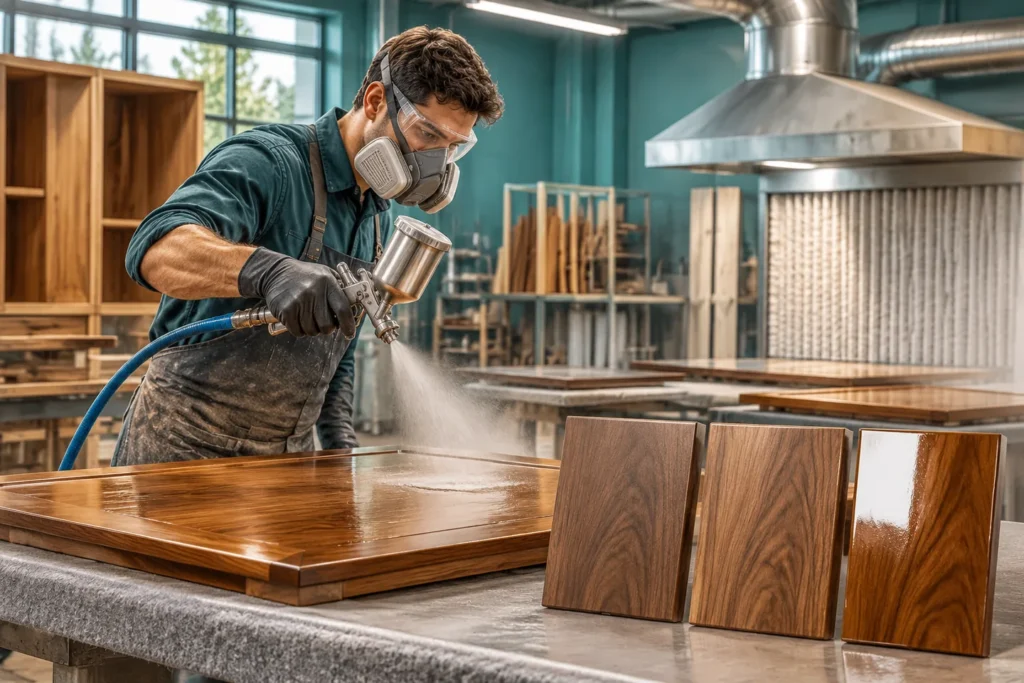
Wood coating selection starts with solid wood, veneer, MDF or plywood and the desired grain, color and sheen. A complete system may include filler, sealer, primer, color layer and topcoat, approved through a physical sample under the intended application conditions.
Wood finishes influence both appearance and production efficiency. A product that looks correct on one timber or spray line may behave differently on veneer, MDF, oily wood or another drying environment.
Identify the substrate
Confirm solid wood species, veneer, plywood or MDF, together with moisture, sanding, pores, resin or oil and any previous finish. End grain and repaired areas can absorb coating differently.
Clear versus colored systems
Clear coatings display natural grain and require careful control of transparency, color change and yellowing. Colored or pigmented systems can provide a uniform appearance but need primer, filling and hiding power appropriate for the substrate.
Choose sheen and touch
Matte finishes are popular for modern furniture but can show polishing or marks if the formulation is not suitable. Satin balances appearance and maintenance. Gloss highlights depth but also reveals surface defects. Approve sheen on a representative panel.
Typical coating build
- Substrate sanding and cleaning
- Filler or pore treatment when required
- Sealer or primer
- Color or stain layer
- One or more protective topcoats
- Curing, sanding and final inspection
Performance and production questions
- Furniture, doors, cabinets, flooring or exterior wood
- Scratch, stain, water, heat or chemical resistance
- Spray, roller, brush or automated line
- Drying temperature, humidity and stacking time
- Color, transparency, gloss and tactile requirement
- VOC, odor or destination-market documentation
Send a physical wood panel and target finish when possible. Color cards alone cannot represent grain, absorption and layer interaction.
Water-based and solvent-based routes
Water-based wood coatings can support lower odor and easier cleanup, while solvent-based systems may offer different flow, penetration, drying and appearance. Neither route is automatically superior for every line. Evaluate spray equipment, temperature, humidity, sanding, curing space and the destination-market requirement.
Testing the approved finish
Depending on the product, buyers may assess adhesion, hardness, scratch resistance, stain resistance, water resistance, heat resistance, yellowing and blocking during stacking. Test results should be linked to the exact substrate, film build and curing schedule because incomplete curing can distort performance.
Production consistency for furniture brands
Keep an approved panel, color reference and sheen tolerance. Record mixing, dilution, application viscosity and number of passes. For repeat orders, control wood variation and confirm whether the factory supplies only coating materials or also supports application trials and line adjustment.
Questions related to this coating topic.
What is the difference between wood sealer and topcoat?+
Sealer helps control absorption and creates a workable base, while topcoat provides the final appearance and protection. Products must be compatible.
Can one clear coat work on every wood species?+
No. Porosity, oils, extractives, color and movement vary. A sample on the actual substrate is recommended.
How is matte sheen approved?+
Apply the complete system to a representative panel and evaluate at the agreed angle and lighting after full curing.