Blog
Beyond the Rust: How to Implement a Professional Anti-corrosion Paint System for Steel Structures?

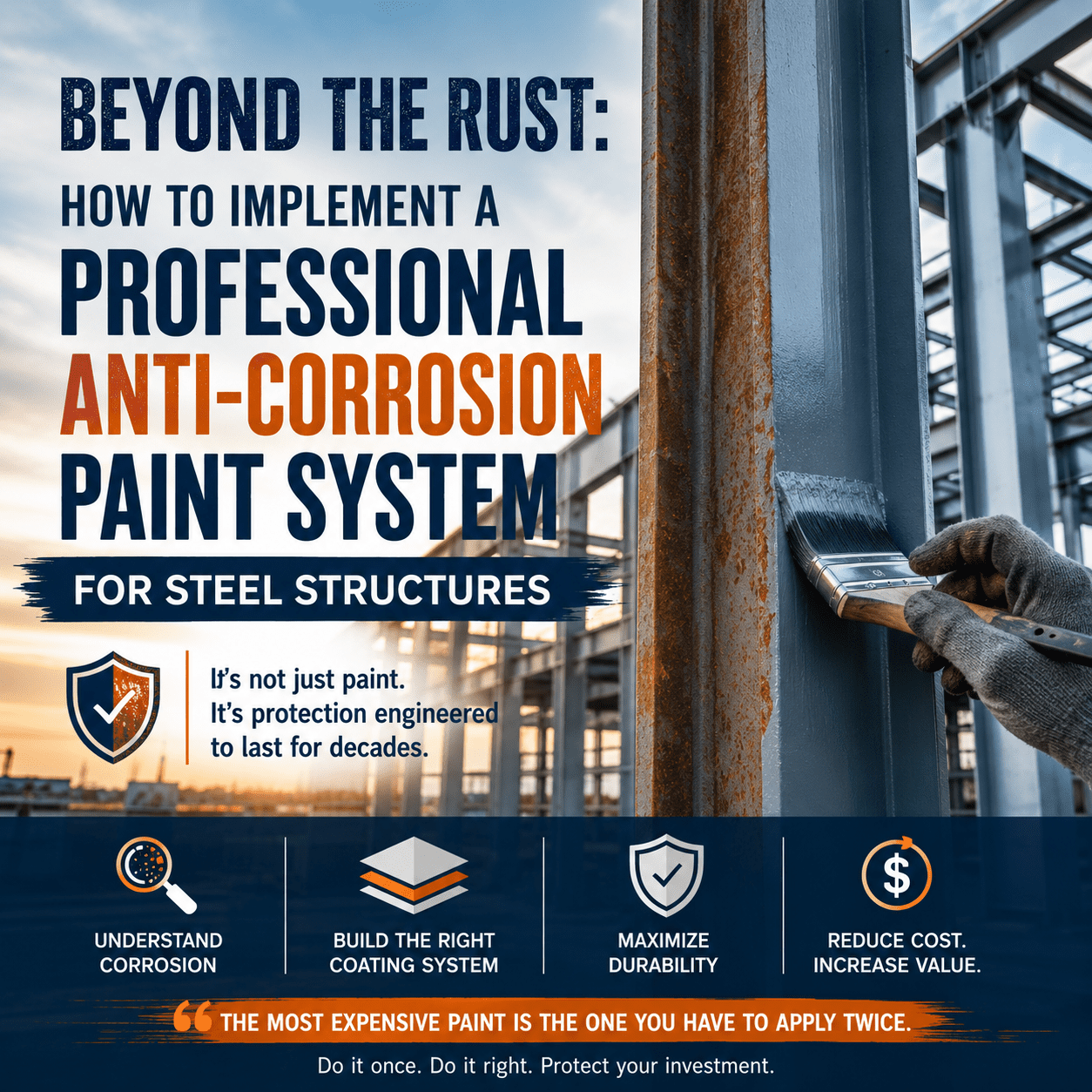
Steel is the skeleton of modern civilization, but it has a silent, relentless enemy: Corrosion.
Every year, billions of dollars are lost globally due to metal degradation. For a building owner or a contractor, "painting" a steel beam is not just about making it look good; it’s about engineering a chemical shield that will last for decades.
In my 20 years of working with Industrial protective coatings, I’ve seen one hard truth: The most expensive paint is the one you have to apply twice. If your Steel structure coating fails after three years, the cost of labor, scaffolding, and downtime will dwarf your initial investment.
This guide breaks down the "How" and "Why" of a professional Corrosion protection system, ensuring your steel stands strong against the elements.
Why Traditional Painting Fails: The "System" vs. The "Can"
The biggest mistake people make is buying a "magic can" of paint and expecting it to do everything. Professional Steel protection is never a single layer; it is a Corrosion protection system designed in layers, similar to how an onion has skins.
Each layer has a specific job:
1. The Primer (The Anchor): This layer must grab the metal and never let go. A professional choice is usually a Zinc-rich primer, which acts as a "sacrificial anode"; if the steel gets scratched, the zinc corrodes instead of the metal.
2. The Intermediate Coat (The Barrier): This is the "thick" part of the sandwich. It creates a maze for moisture and oxygen, making it nearly impossible for rust-causing elements to reach the primer.
3. The Topcoat (The Shield): This layer faces the sun and rain. It provides UV resistance and ensures the Anti-corrosion paint doesn't "chalk" or fade under intense sunlight.
Choosing Your Weapon: Water-based vs. Solvent-based
The industry is currently in a massive transition. For years, solvent-based paints were the only option. Today, Water-based steel paint has closed the performance gap.
1. Water-based steel paint——The Modern Choice
Pros: Low VOCs (Environmentally friendly), non-flammable, and very easy on the workers. You can apply it indoors without a gas mask.
Best For: Modern office structures, schools, and any project that requires "Green" certification.
2. Rust conversion paint——The Maintenance Hero
If you are repairing an old building where you cannot sandblast the rust away, Rust conversion paint is your best friend. Instead of just covering the rust, it chemically transforms red rust (Iron Oxide) into a stable, black, non-porous layer. It’s like turning a weakness into a strength.
The Professional Construction Guideline: Step-by-Step
To achieve a 15–20 year lifespan, you must follow these steps precisely. There are no shortcuts in Industrial coating.
Step 1: Surface Preparation
You can buy the most expensive Anti-corrosion paint in the world, but if you put it on a dirty surface, it will fail.
- Cleaning: Use high-pressure water or solvent to remove oil and grease.
- Abrasive Blasting: For new steel, you want a "Sa 2.5" level finish—this means the steel looks like a dull gray stone and has a "profile" (roughness) that the paint can bite into.
- Manual Cleaning: For small repairs, use a wire brush to reach an "St 3" level.
Step 2: Mixing and Pot Life
Most professional Steel structure coatings are two-component (Part A and Part B).
- The Rule: You must mix them with a mechanical stirrer, not a stick.
- The Clock: Once mixed, you have a "Pot Life" (usually 4–6 hours). If you try to use the paint after the pot life has expired, it won't bond, even if it still looks liquid.
Step 3: Application Tools
- Airless Sprayer: This is the standard for big projects. It applies a heavy, even coat without adding air bubbles.
- Brush & Roller: Use these only for "stripe coating" (corners and edges) or small touch-ups. You cannot reach the required thickness with just a brush.
The Numbers That Matter: Thickness and Conditions
In the world of Anti-corrosion paint, we don't guess. We measure.
1. Recommended Thickness (DFT)
We measure "Dry Film Thickness" in microns (μm).
- C3 Environment (Inland/Standard): Total system thickness of 120–160 microns.
- C5 Environment (Coastal/Chemical): Total system thickness of 240–320 microns.
- Expert Tip: If your Dry Film Thickness (DFT) is too thin, the paint is porous. If it’s too thick, it might crack. Use a digital DFT gauge to check every square meter.
2. Environmental Precautions
- Temperature: Surface temperature must be at least 3°C above the dew point. If the steel is cold, invisible moisture will be trapped under the paint, leading to "flash rust."
- Humidity: Avoid application if humidity is above 85%.
Maintenance: The ROI of "Doing it Right."
Think of Steel structure coating as health insurance for your building.
- Inspection: Every 2–3 years, do a visual check. Look for "tea staining" (small brown dots) or bubbling.
- Spot Repair: If you find a small rust spot, apply rust-conversion paint immediately. It prevents the "cancer" from spreading.
By investing in a high-quality Water-based steel paint system and following the correct Construction Guideline, you reduce your long-term maintenance costs by up to 60%.
FAQ: Common Questions from the Field
Q: Can I skip the primer if the steel looks clean?
A: Absolutely not. The primer is the chemical anchor. Without it, the Anti-corrosion paint will eventually "sheet off" like a plastic bag.
Q: How long does it take to dry?
A: Most modern systems are "touch dry" in 2 hours, but they need 7 days to fully "cross-link" and reach maximum hardness. Don't subject the steel to heavy rain or chemicals before this period.
Q: Why is my paint peeling in the corners?
A: This is usually due to "Stripe Coating" failure. In professional work, we paint the corners and welds by hand before we spray the whole surface. This ensures the most vulnerable spots have enough thickness.