Blog
Beyond the Gloss: A Field Guide to High-Performance Epoxy Floor Coating

Why Your Epoxy Floor Coating Failed and How to Ensure It Never Happens Again
Let’s get one thing straight: most people don't have an "epoxy problem"; they have a "concrete problem."
In my fifteen years of crawling on cold warehouse floors and managing high-stakes industrial floor coating projects, I’ve seen thousands of square feet of beautiful resin literally peel off like a bad sunburn. Why? Because the industry has been flooded with "magic-in-a-can" DIY kits that promise the world but ignore the fundamental chemistry of concrete surface preparation.
If you are looking for a shimmering finish that actually survives a forklift's tire-spin or a chemical spill, you need to look past the marketing gloss. This guide isn't about the "pretty colors", it’s about the grit, the bond, and the long-term ROI of a professional durable resin flooring system.
The Technical Truth: 100% Solids vs Water-Based Systems
When you search for epoxy floor coating, you’ll see price points that vary wildly. This isn't just a markup; it’s a difference in molecular density.
- Water-Based/Solvent-Based Epoxies: Think of these as thin "paint plus." They are easy to roll on, but as they cure, the water evaporates, leaving a thin, brittle film. They are fine for a light-traffic basement, but they will fail under the heat of high-performance tires.
- 100% Solids Epoxy: This is the gold standard for industrial floor coating. There is no evaporation. If you put down 10 mils of wet product, you get 10 mils of dry, rock-hard protection. It offers superior chemical resistance and impact strength. It’s harder to work with (shorter "pot life"), but it’s the only choice for a true garage floor coating that won't show hot-tire pickup.
Concrete Surface Preparation: The Step 90% of People Skip
I tell my clients: "You’re paying me 20% for the epoxy and 80% for the preparation." If your contractor shows up with a bucket of acid and a garden hose, fire them immediately.
To achieve a mechanical bond, the concrete must be "open." We use the CSP (Concrete Surface Profile) scale. For a standard epoxy floor coating, we aim for a CSP 2 or 3. This is achieved via:
- Diamond Grinding: Using planetary grinders to shave off the "laitance" (that weak, dusty top layer of concrete).
- Shot Blasting: For heavy industrial floor coating needs, we blast the floor with steel pellets to create a rough texture that the resin can "grab" onto.
- Moisture Testing: This is the silent killer. We use Calcium Chloride tests or relative humidity (RH) probes according to ASTM F2170 standards. If your concrete is "breathing" too much moisture, your resin flooring will blister and delaminate within six months.
Addressing the "Vapor Barrier" Myth
A common mistake in the garage floor coating world is assuming epoxy is a waterproof seal from both sides. It’s not. If you have hydrostatic pressure coming from underneath the slab, you need a specific moisture vapor barrier primer before your base coat. Skipping this is the number one reason for "bubbling" in residential projects.
The Layered Architecture of a High-Performance Floor
A professional epoxy floor coating is a system, not a single coat. On our job sites, we follow a strict multi-stage protocol:
- The Primer: A low-viscosity resin that penetrates deep into the concrete pores.
- The Base/Body Coat: This provides the thickness and the primary color. If we are doing a slip-resistant finish, this is where we broadcast quartz or aluminum oxide.
- The Decorative Layer: Whether it’s vinyl flakes for a garage floor coating or metallic pigments for a showroom, this adds the aesthetic "wow" factor.
- The Topcoat (Polyaspartic or Urethane): Epoxy is tough, but it hates UV light. It will yellow (chalk) over time if exposed to the sun. We always finish with a UV-stable topcoat to ensure scratch resistance and color retention.
Maintenance: The "No-Wax" Reality
One of the biggest selling points of industrial floor coating is the ease of cleaning. Because the surface is non-porous, oils and chemicals sit on top rather than soaking into the slab.
However, "low maintenance" doesn't mean "no maintenance." Sand and grit act like sandpaper under foot traffic. For a durable resin flooring system, a simple weekly mop with a pH-neutral cleaner is all you need. Avoid citrus or vinegar-based cleaners, as the acid can eventually dull the high-gloss finish.
Is the Investment Worth It? Calculating ROI
Let’s talk numbers. A high-quality epoxy floor coating can cost significantly more upfront than bare concrete or cheap floor paint. But let’s look at the lifecycle:
- Concrete Dusting: Uncoated concrete constantly "dusts," which destroys HVAC filters and clogs sensitive machinery.
- Safety: By adding a slip-resistant finish, you drastically reduce workplace accidents and insurance liabilities.
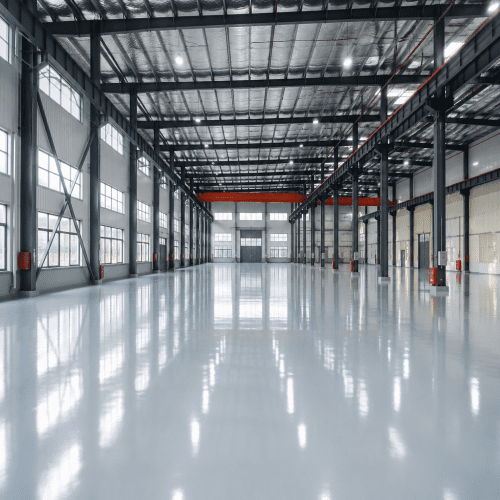
- Reflectivity: A high-gloss industrial floor coating can increase brightness by up to 200%, potentially lowering your electricity bill for overhead lighting.
In my experience, an expertly installed garage floor coating adds more to your home's resale value than the cost of the installation itself. It turns a "utility space" into a "finished room."
Final Verdict: DIY or Pro?
If you just want to tidy up a storage closet, go to the big-box store. But if you are protecting a five-figure vehicle or a million-dollar production line, hire a specialist. The equipment required for proper concrete surface preparation, industrial vacuums, grinders, and moisture meters, costs more than the floor itself.
Don't settle for a floor that looks good for a month. Invest in a durable resin flooring system that stands the test of time, chemicals, and heavy loads.