Blog
The Science of Metal Longevity: An In-depth Analysis of Anti-corrosion paint and Rust conversion paint Systems

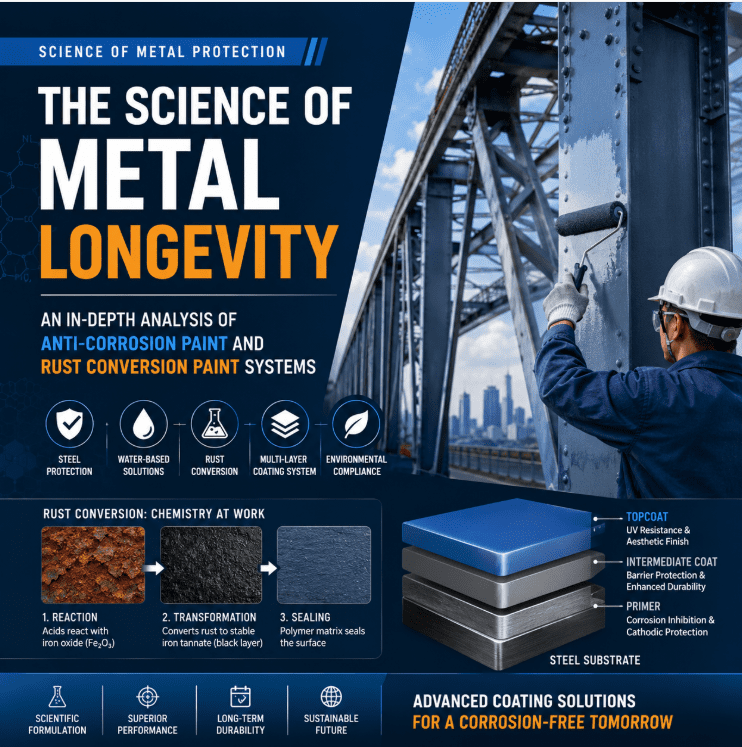
Metal, particularly carbon steel, is the backbone of modern infrastructure. However, the inherent electrochemical instability of iron leads to the inevitable process of oxidation, or corrosion. Globally, the cost of metal corrosion is estimated at 3-4% of global GDP annually. To mitigate this, the coatings industry has evolved from simple barriers to complex, reactive Metal coating systems.
Selecting the appropriate Anti-corrosion paint requires more than an aesthetic choice; it necessitates an understanding of environmental corrosivity, substrate chemistry, and the molecular transition of oxides. This guide analyzes the technical architecture of modern metal protection, focusing on the shift toward Water-based steel structure paint and the innovative utility of Rust conversion paint.
The Electrochemical Battle: How Corrosion Occurs
To protect metal, one must understand its enemy. Corrosion is an electrochemical process where the metal surface acts as an electrolytic cell. For rust to form, four elements must be present: an anode (the metal), a cathode, an electrolyte (moisture), and a metallic path (the steel itself).
Anti-corrosion paint works by interrupting this circuit. It achieves this through three primary mechanisms:
1.Barrier Protection: Creating a non-porous layer that prevents water and oxygen from reaching the substrate.
2.Inhibitive Protection: Using pigments that chemically interfere with the corrosion process at the anode or cathode.
3.Sacrificial (Galvanic) Protection: Utilizing a more active metal (like zinc) that corrodes in place of the steel.
The Professional Architecture: The Three-Layer Anti-corrosion paint System
In high-stakes industrial environments, a single coat of paint is insufficient. A professional Metal coating system typically adheres to the ISO 12944 standard, utilizing a layered approach to ensure long-term integrity.
- The Primer (The Foundation)
The primer is the most critical layer for adhesion. In steel structures, a Zinc-rich primer is often specified. The high zinc content provides cathodic protection; even if the coating is scratched, the zinc will oxidize first, keeping the underlying steel intact.
- The Intermediate Coat (The Barrier)
The intermediate layer, often formulated with Micaceous Iron Oxide (MIO) or epoxy resins, serves to increase the "Dry Film Thickness" (DFT). Its primary role is to create a tortuous path for moisture and ions, effectively shielding the primer from environmental stress.
- The Topcoat (The Shield)
The topcoat provides UV resistance and aesthetic finish. In modern architecture, high-performance polyurethanes or fluorocarbons are used to prevent "chalking" and maintain color retention over decades of sun exposure.
The Evolution of Water-based Steel Structure Paint
Historically, the metal coating industry relied on solvent-based systems (like alkyds and epoxies) for their fast drying and high adhesion. However, the rise of global environmental regulations (such as LEED and REACH) has accelerated the development of Water-based steel structure paint.
Advantages of Water-borne Technology:
1.Low VOC Emissions: Unlike solvent-based paints, Water-based steel structure paint utilizes water as the carrier, drastically reducing volatile organic compound emissions. This makes it ideal for indoor steel structures, hospitals, and schools.
2.Safety and Compliance: These systems are non-flammable and lack the toxic odors associated with traditional thinners, improving the working environment for applicators.
3.Performance Parity: Modern water-borne acrylic and epoxy resins have achieved performance parity with solvent systems, offering excellent salt-spray resistance and adhesion to various metal substrates.
For a Water-based steel structure paint to be effective, the application environment must be strictly controlled. High humidity or low temperatures can hinder water evaporation, potentially leading to "flash rust" if the coating remains wet for too long.
Rust conversion paint: Chemistry Instead of Sandblasting
In maintenance and repair scenarios, traditional "white metal" sandblasting is not always feasible due to site restrictions or costs. This is where Rust conversion paint (also known as a Rust converter) provides a chemical solution to an engineering problem.
How Rust Conversion Paint Works at a Molecular Level?
Unlike standard paint that merely covers rust, a Rust converter contains active ingredients, typically tannic acid or phosphoric acid, that react with iron oxide (red rust).
- Reaction Phase: The acid reacts with the porous iron oxide (Fe2O3).
- Transformation Phase: The red rust is chemically converted into a stable, black, non-porous organometallic complex, often referred to as iron tannate or magnetite.
- Sealing Phase: The polymer matrix in the Rust conversion paint then seals this converted layer, creating a primed surface ready for a decorative topcoat.
This process eliminates the need for aggressive mechanical cleaning, though it still requires the removal of "loose" scale and oil before application. It is a highly efficient Steel protection strategy for aging infrastructure, bridges, and storage tanks.
Technical Standards and Environmental Classification
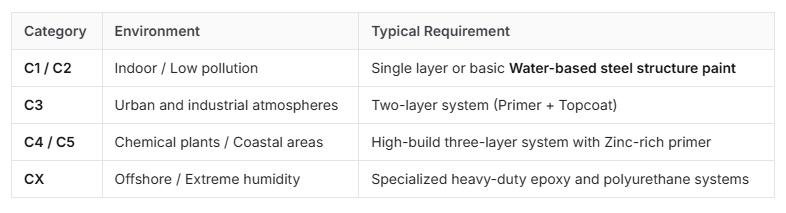
A professional Anti-corrosion paint specification must align with the environmental corrosivity categories defined by ISO 12944:
Surface Preparation: The Silent Factor of Failure
Statistics show that 80% of Anti-corrosion paint failures are caused by improper surface preparation rather than the paint itself. For any Metal coating system to succeed, the substrate must be:
- Clean: Free from grease, oil, and salts.
- Dry: Surface temperature should be at least 3°C above the dew point.
- Rough: Possessing a "mechanical profile" that allows the resin to anchor deep into the metal.
When utilizing Rust conversion paint, the surface must be wire-brushed to remove flaky rust, but it requires a thin layer of intact rust to react with. Applying a converter to bare, clean steel will result in poor adhesion.
FAQ: Technical Insights for Engineers and Contractors
Q: Can I apply Water-based steel structure paint directly over old solvent paint?
A: Generally, yes, provided the old coating is stable and has been sanded to create a profile. However, a "patch test" for compatibility is always recommended to ensure no solvent-entrapment or lifting occurs.
Q: Is Rust conversion paint a permanent solution for structural steel?
A: It is an excellent maintenance solution. However, for primary structural steel in high-corrosivity environments (C4/C5), traditional abrasive blasting followed by a high-performance Anti-corrosion paint system is still the industry gold standard for 20+ years of protection.
Q: How do I measure the success of an anti-corrosive coating?
A: Success is measured by "Dry Film Thickness" (DFT) using an ultrasonic gauge and through "Adhesion Testing" (ASTM D3359). A consistent DFT ensures there are no "weak spots" for ions to penetrate.